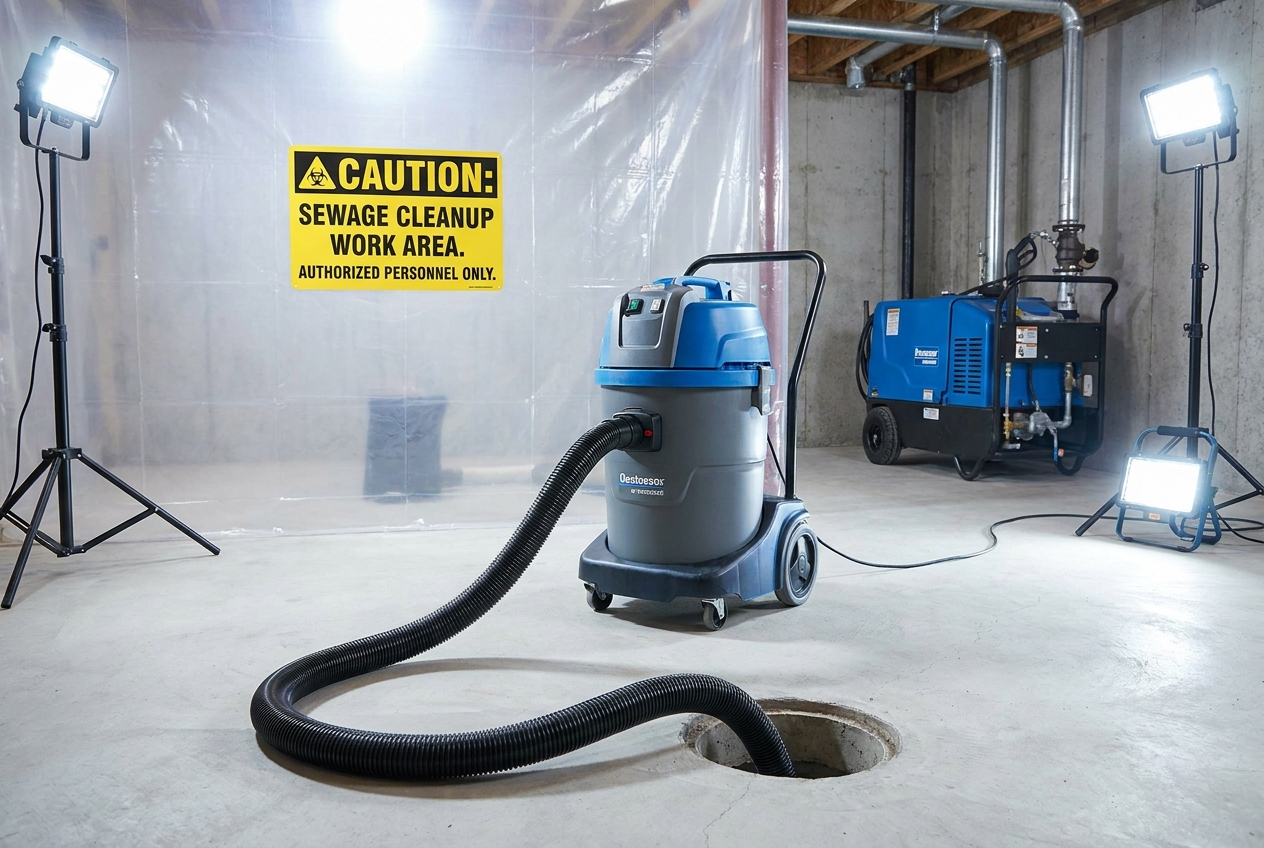
Robinson Restoration handles category 3 sewage cleanup across Washington and Oregon with biohazard-certified crews. We contain the area, remove contaminated porous material, decontaminate and dry the structure, and document every step for your insurance carrier.
The next 30 minutes matter. Here's what helps and what makes it worse.
Keep kids and pets far from the affected area
Stop running water; don't flush or drain anything
Turn off HVAC so air doesn't circulate contamination
Photograph the scene from a safe distance for your claim
Call us, any hour. We'll walk you through the rest
Don't wade through standing sewage, even in boots
Don't try to mop, shop-vac, or bleach it yourself
Don't run fans; airflow spreads aerosolized bacteria
Don't touch electrical outlets or panels near the water
Don't keep porous items that soaked; we'll document them for replacement
The restoration industry classifies water losses into three categories, and sewage sits in the worst one. Category 3, or "black water," carries whatever went down the drain plus whatever lives in the sewer line: E. coli, salmonella, hepatitis A, and parasites you can't see or smell.
That classification isn't paperwork. It changes everything about the cleanup. Porous materials that touched the water, like carpet pad, drywall, and insulation, get removed rather than dried. Hard surfaces get cleaned, disinfected with EPA-registered products, and verified. Crews work in full PPE under containment so contamination doesn't travel into the rest of your home.
Common causes we respond to across WA and OR: main line blockages, tree root intrusion into old pipes, sump and ejector pump failures, and municipal backups during heavy rain. Whatever the cause, our process is the same careful one, and it's covered by many policies with a sewer backup rider. We'll help you find out.
Curious what's actually at stake? We wrote up the honest version on the blog: the hidden dangers of a sewage backup.
The highest contamination class in the IICRC S500 standard. Full biohazard protocol, no shortcuts.
Bacteria multiply fast in warm, wet materials. The sooner extraction starts, the less has to be torn out.
Area sealed, HVAC off, crew in full PPE before anything is touched.
Sewage and solids removed with dedicated extraction equipment.
Saturated porous materials bagged out under containment.
EPA-registered antimicrobials on every affected surface.
Structural drying to IICRC S500 targets, moisture-verified daily.
Many policies need a rider. We review yours before you file and bill the carrier directly.
Most homeowners policies treat a sewage backup as its own animal. The base form usually responds to sudden, accidental water damage that starts inside the house, while anything that comes up through a drain, floor drain, or sewer line falls under a water backup endorsement you either bought or you didn’t. That endorsement carries its own limit, separate from your dwelling coverage and often much smaller, so knowing the number early shapes the plan.
Cause of loss decides the rest. A blockage on your side of the property line reads differently than a municipal main that surcharged during a storm, and when the public system is involved there is usually a separate claims process with its own filing deadline. Gradual seepage from a failing line tends to get denied as deferred maintenance. We document what we find, in writing and in photos, and let the adjuster make the coverage call.
A sudden backup through a drain or sewer line when the water backup endorsement is on your policy. Extraction, decontamination, demolition, drying, and affected contents all draw against that one limit.
Slow drain-line seepage, a root problem you were warned about and left alone, and groundwater or river flooding. Flood is its own separate policy and never part of a homeowners form.
Photos taken before anything is demolished, the category and class of the loss, moisture readings and daily drying logs, a room-by-room contents inventory, and a line-item estimate that explains every removal.
Direct to your carrier at the pricing adjusters expect, so you cover the deductible rather than the whole invoice. No coverage? You get a written price before we go past emergency work.

Nobody can price a sewage job honestly over the phone, and you should be skeptical of anyone who tries. The number tracks the work, and the work depends on where the contamination traveled, what it soaked into, and how hard that space is to reach. Three things move it most.
Two inches of sewage contained to a bathroom floor can be a smaller job than a half inch that ran down a hallway and under three doorways. Contaminated water wicks up drywall, slides beneath cabinet toe kicks, and follows subfloor seams into rooms that look bone dry. Mapping the true perimeter with moisture meters is what sets the real scope, before anything gets torn out.
A tiled bathroom over slab, a finished basement full of built-ins, and a crawlspace you have to belly crawl through are three very different labor days. Cabinets that come apart in pieces, flooring bonded to concrete, and cramped working room all add hours before a single air mover gets placed. Hauling and disposing of category 3 material carries its own cost as well.
Once contaminated material is out, the structure still has to reach a documented dry standard. How many air movers and dehumidifiers get set, and how long they run, comes from psychrometric readings taken at each monitoring visit rather than a guess. Dense assemblies like hardwood over plywood, or concrete that took on moisture, hold water longer and stretch both the timeline and the equipment line.

So much of the region’s housing sits over a vented crawlspace or a partly finished basement, and that is exactly where sewage ends up. Gravity picks the lowest opening every time. What happens down there works differently than a first-floor bathroom loss, and it gets underestimated constantly.
The vapor barrier under your house is a sheet of plastic, not a containment liner, so contaminated water runs off it and into bare soil. Out comes the barrier and any wet batt insulation, the top layer of affected soil gets removed, the ground is treated, and joists and subfloor are cleaned and dried from underneath. Odor rides warm air up through the floor until that work is done.
In a lot of homes here the furnace trunk and flex runs live in the crawlspace, with register boots opening straight into bedrooms. When sewage gets inside flex duct, the inner liner can’t be reliably disinfected, so that run gets replaced instead of wiped down. Firing the system back up with contaminated duct in place just distributes the problem to every room in the house.
Basement floor drains, laundry standpipes, and ejector pump pits sit at the bottom of the plumbing system, which means they take the backup before anything upstairs notices. In a finished basement the water gets behind baseboard and into wall cavities within minutes. Once cleanup is done, ask your plumber about a backwater valve, because those same fixtures will be first in line again.
Sewage cleanup cost depends on how much of the structure the contamination reached, which materials absorbed it, the containment and equipment the space requires, the number of drying days, and whether the job carries through rebuild. Robinson Restoration inspects the property first, maps the affected area with moisture readings, and writes a line-item estimate. Nothing beyond emergency work starts until you’ve approved that scope.
Sewage work happens inside a sealed envelope. Poly barriers, negative air machines, HEPA filtration, decon chambers, and disposable PPE all get built and replaced daily. The bigger that envelope, and the longer people keep living around it, the more the setup costs.
Every soft item the water touched has to be photographed, inventoried, and either cleaned off-site or disposed of as contaminated waste. A packed garage or a finished basement full of boxes takes crew hours before demolition starts, and that labor lands on the estimate.
Some jobs close on our own moisture logs and post-cleaning inspection. Commercial spaces, rental units, and homes with immunocompromised occupants often need a third-party hygienist to write the protocol and clear the work. That adds sampling, more visits, and a hold on rebuild.
Drying the structure to standard is where the emergency scope ends. Putting back flooring, drywall, cabinets, and finishes is a separate stage that Robinson manages through vetted licensed contractors and sister companies. Permits and current code requirements on that rebuild carry their own cost.
If your policy carries a water backup endorsement and the carrier accepts the loss, you generally pay the deductible plus anything above that endorsement’s limit, and we bill the balance directly. Denials happen. If it’s denied, you get a written price first.
Call dispatch any hour. Tell us where the water came up, how long it sat, what rooms it reached, and whether you carry a backup endorsement.
"I had sewage come up through my shower. Robinson Restoration was on-site fast, walked me through the insurance claim, handled the extraction and decontamination, and rebuilt the bathroom and hallway floors. Floor looks better than it did before the loss."
Terry Dunfield · Portland, OR
Sewage backups don’t wait for business hours, and neither do we. Our coverage runs across Washington and Oregon, with crews who know the local housing stock and the aging lines underneath it. Pick your city for details and dispatch that puts us on-site in 90 minutes.
We get why you'd want to. But even a small backup contaminates more than it appears to, and household cleaners don't disinfect porous materials like carpet pad or drywall. Anything bigger than a toilet splash deserves professional equipment and PPE. The health risk isn't worth saving a service call, and DIY cleanup can actually complicate an insurance claim.
Often, but usually through a separate sewer backup rider rather than the base policy. Coverage also depends on the cause: a blockage on your line is treated differently than a municipal main backing up. We review your policy with you before anything is filed and document the cause carefully, because that determines the outcome.
Porous materials that absorbed contaminated water: carpet and pad, upholstered furniture, mattresses, particle-board furniture, and usually the lower portion of affected drywall and insulation. Hard, non-porous items can typically be cleaned and disinfected. We inventory and photograph everything removed so your claim reflects the full loss.
Fast. Bacteria multiply by the hour in warm, wet materials, and the contamination wicks upward into walls the longer it sits. Same-day extraction usually means less demolition, a shorter dry-out, and a smaller claim. Our crews dispatch around the clock and arrive within 90 minutes across our service area.
No, and if it does, we're not done. Odor after cleanup means contamination is still present somewhere. Our process removes the source material, disinfects every affected surface, and treats the air with HEPA filtration. We don't mask smells with fragrance and call it finished.
The usual suspects in the Northwest: tree roots working into aging clay or Orangeburg pipes, grease and wipe blockages, failed sump or ejector pumps, and overloaded municipal systems during heavy rain. After cleanup we'll tell you what caused yours, and a plumber can fix the line so it doesn't happen twice. We wrote more on the warning signs on our blog.
Once the contaminated material is gone, every affected surface has been cleaned and treated with an EPA-registered antimicrobial, and the structure has dried to a documented standard. Until then the work area stays sealed under containment with negative air and HEPA filtration, and most families keep living in the rest of the home. If anyone there is pregnant, elderly, immunocompromised, or asthmatic, say so at the start and we’ll build containment around that.
No, that belongs to a licensed plumber, and it needs to happen before we button things up or the line will back into finished work. We’ll tell you exactly what we found and coordinate scheduling so both trades aren’t in the same space fighting for room. Rebuild is its own stage too. Robinson manages that through vetted licensed contractors and sister companies, so you keep one point of contact instead of chasing subs yourself.
Generally the structure and the drain line are the owner’s, along with any habitability issue the backup creates, while a tenant’s personal belongings fall to their renters policy if they carry one. Leases and state landlord-tenant rules vary enough that you should read yours before assuming. On our end, we bill the owner or the owner’s carrier, arrange access windows that work for occupants, and keep documentation for the building separate from documentation for tenant contents.
One call and a biohazard-certified crew is on the way. We'll tell you exactly what to do until they arrive.
Licensed · Insured · Biohazard Certified · Serving Washington & Oregon