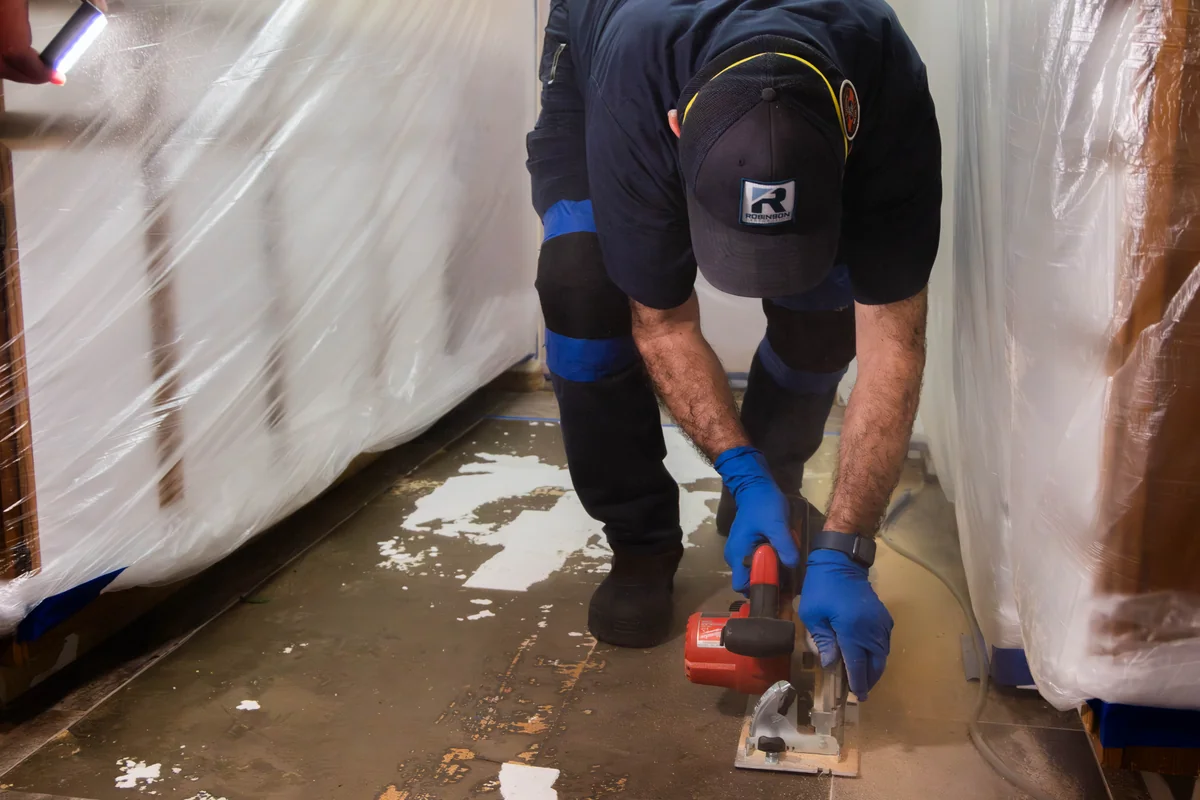
Robinson Restoration is an IICRC-certified water damage restoration company serving McChord Afb, WA. Crews dispatch 24 hours a day, arrive on-site in 90 minutes or less, document the readings and photos your carrier needs, and bill your insurance directly on covered claims.
Water damage on a military schedule does not wait for the duty day to end. Crews serving the McChord AFB side of Joint Base Lewis-McChord handle burst supply lines, overflowed laundry, and water heater failures in quarters on the installation and in the rentals just outside the gates. Dispatch answers around the clock.
Housing in this corridor runs from renovated mid-century base quarters to privatized family units to 1970s and 1980s rentals in the surrounding Pierce County neighborhoods. Most of it sits on the gravelly outwash prairie south of Tacoma, where soil drains quickly but slab and crawlspace construction still traps whatever leaks inside. Winter rain here is relentless rather than dramatic, and it finds tired flashing, failed door pans, and gutters nobody cleared.
Our Kent crews cover the JBLM corridor with 24/7 dispatch and a standard of on-site in 90 minutes. Because base and rental housing usually involves a housing office or a property manager, we document heavily: moisture maps, daily readings, photos of every affected assembly, and a scope written to IICRC S500. That file goes to your carrier and we bill them directly. Rebuild work, when it is needed, gets managed through vetted licensed contractors.

Crews stage for the JBLM corridor overnight, ready for quarters on the installation and off-base rentals alike, with documentation built for housing offices and carriers.
24 hours a day, 7 days a week, our crews dispatch the moment you call and start mitigation the same visit. Call dispatch or message us for immediate help.
We stop further damage with commercial extraction, structural drying, and antimicrobial treatment, and we walk you through the entire insurance claim as we work.
We manage your rebuild to pre-damaged condition through our trusted network of licensed contractors and sister companies. One manager, one timeline.
A lot of family housing here is duplex or townhome style, so a single failed line rarely stays in one unit. Water tracks along the bottom plate and into the neighbor's wall cavity within hours. We contain both sides, meter both sides, and keep a separate damage record for each unit so the housing office and the carriers are not working from one blurred file.
Deployments, TDY, and PCS moves leave homes closed up for weeks at a stretch. A slow supply leak that would be a mop-up on a normal Tuesday becomes a floor replacement when nobody is home to hear it. Turning the main off before extended travel, and asking a neighbor to walk the house, prevents more losses around here than any device you can buy.
The ground south of Tacoma is glacial outwash, gravelly and fast draining until the storm outpaces it. Slab-on-grade homes then take water at the perimeter, especially where a downspout dumps at the foundation instead of running to a drain line. The first sign is usually damp carpet along an exterior wall, weeks before anyone suspects the grading.
Water heaters in this housing stock frequently live in an unconditioned garage or a utility closet with no drain pan under them. When a tank finally lets go it releases forty or fifty gallons at once and then keeps feeding until somebody closes the cold inlet. Shared garage walls mean the water reaches finished space almost immediately.
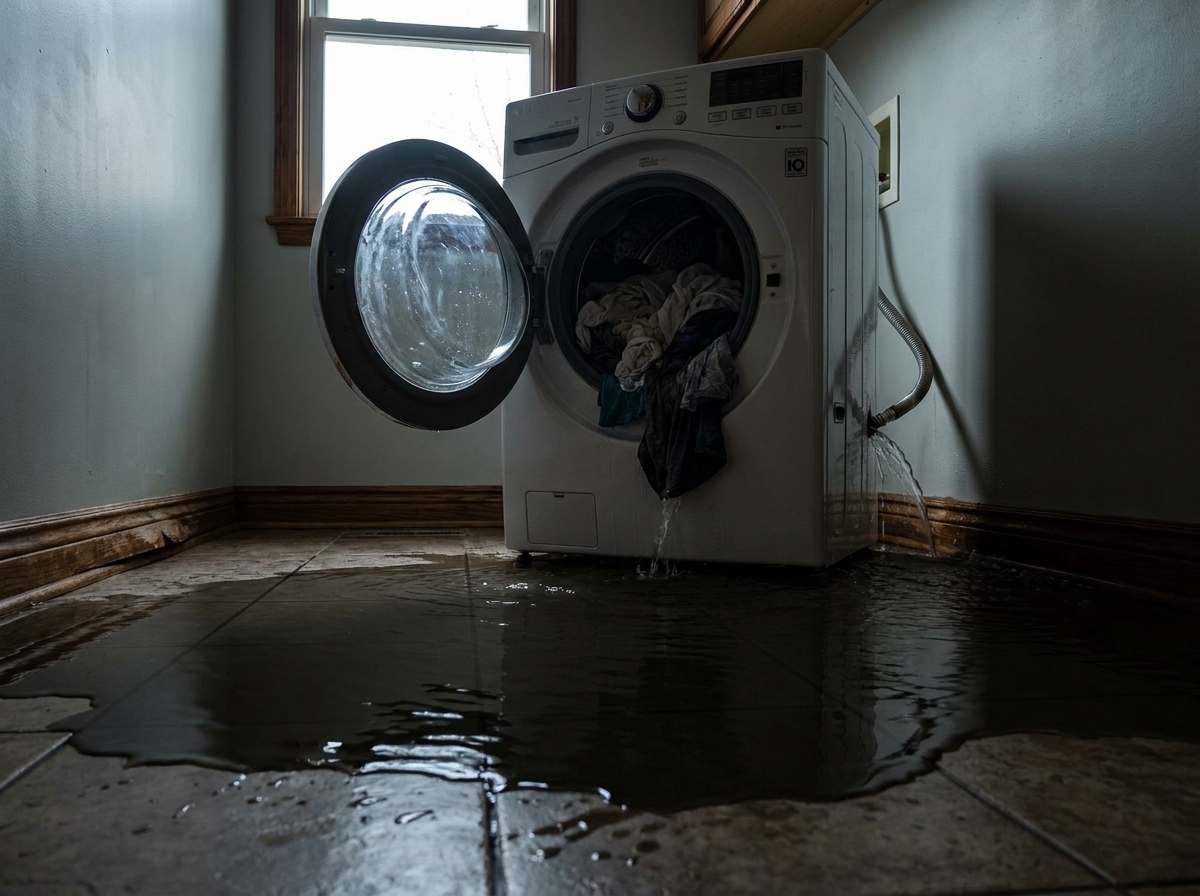
Most of the losses we run in McChord Afb start one of three ways: appliance failures, burst and leaking pipes, and water heater failures. Here is why each one happens here, and what it takes to dry it properly.
Stacked washer and dryer units in tight laundry closets are standard in this housing, and a split hose sprays into a wall cavity where the pan cannot catch it.
Pierce County gets a few hard freezes each winter, and lines in uninsulated garages, exterior walls, and crawlspaces are the first to split when the temperature drops overnight.
Tanks in garages and utility closets rust out from the bottom. Without a pan and a routed drain line, the whole tank empties into the adjoining living space before anyone notices.
Water is how most losses start. It’s rarely where they end. The same local crew handles all of it.
Three real projects, photo-documented for the insurance carrier. Drag each handle to compare.
“Chuck and Cole were very professional, courteous and knowledgeable about their restoration skills including close out processes. I'm really happy they were the two employees assigned to our home.”
Joanna Gamble · Google Review
“We hired Robinson Restoration after a boiler joint failed and leaked what we thought was a small amount of water in our laundry room, but turned out to be more serious than it appeared. They did a fantastic job from first contact to insurance claim approval.”
Randi Covin · Google Review
“We had a major sewer back up a couple of weeks ago, into the laundry room and downstairs bathroom. Panic! We were referred to Robinson Restoration and what a blessing. The whole crew has been wonderful.”
Lynn Dee King · Google Review
In Washington, you choose your restoration contractor, and your carrier can’t penalize you for it. We document every McChord Afb loss with moisture maps, photos, and daily readings, then bill your insurer directly. You pay your deductible. That’s it.
Subject to policy coverage and deductible. We handle the paperwork, photos, and adjuster calls.
Base housing and the surrounding neighborhoods are part of the area our Pierce County crew works daily. Dispatch answers 24/7, so a burst line at 3 a.m. gets a truck moving right away. Crews sent to McChord Afb pull in with extraction units and commercial drying equipment, and we bill insurance carriers directly after documenting the loss.
We can, and we follow the installation's access procedures rather than working around them. In practice that means you or your housing office coordinates access and we bring the documentation the housing office and your carrier both need. Our part does not change: extraction, containment, drying to IICRC S500, and a photo-backed file. Call our 24/7 line first so we can start that coordination immediately.
That depends on your housing arrangement. In privatized or government quarters the housing office or property manager usually authorizes structural drying, while your personal property claim runs through your own renters policy. In an off-base rental it is typically the landlord for the building and you for your belongings. We write the scope so each party sees exactly what belongs to them, which keeps the job from stalling.
Shut off the water at the main, cut power to any wet room at the breaker, and call us. We can walk a spouse through documenting the loss on a phone before anything is moved, which protects the claim later. We also keep a single point of contact on file so updates, readings, and photos go to whoever you designate, including a service member on a different time zone.
A renters policy generally covers your personal property when the water comes from a sudden failure like a burst pipe or an appliance, and it often includes loss of use if the unit is not livable during drying. The building itself belongs to the owner's policy. Read your declarations for the water backup line, since backup from a drain is commonly excluded unless you carry that endorsement.
Usually not for the structure, though the fastest path is still one crew drying both sides at once. Water crossing a shared wall creates two separate damage records and sometimes two separate policies, so we meter and photograph each unit independently. That way nobody argues about whose wall cavity was wet, and the housing office or property manager gets a clean accounting of the whole affected footprint.
Most residential losses in this corridor dry in three to five days once equipment is set, longer when water reached insulation or got under cabinets and hardwood. We take readings daily and pull equipment when the affected materials match a dry standard from an unaffected area, not on a fixed schedule. You will see the numbers each day, so the end of the job is a measurement rather than an opinion.
Standing water gets worse by the hour. Call our 24/7 line and we will get a crew moving toward you.
Licensed · Insured · IICRC Certified · Serving Washington & Oregon